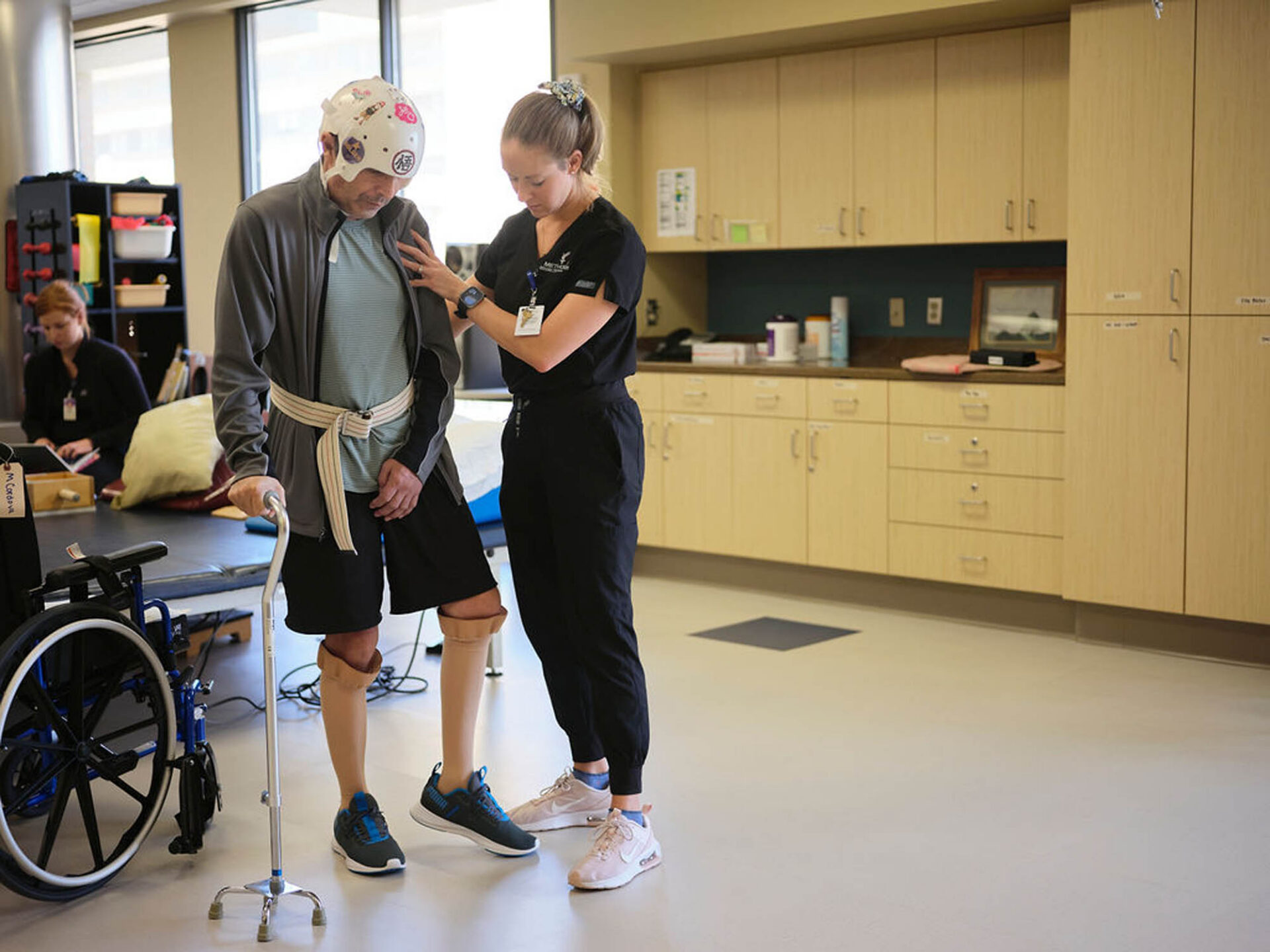
Once the medical team stabilizes your loved one, the brain can begin to recover. The speed of the recovery depends on how severe the brain injury was, the location of the injury in the brain and length of time since the injury. The recovery process can take several months and during that time you may see changes in your loved one. Below is a list of stages your loved one may go through. Each person progresses through these stages differently. Some people may progress through each stage while others may progress to a certain level and remain there.
Coma and Vegetative Stage: (Level 1 and 2):
- Loved ones do not respond to any stimuli and appear in a deep sleep (Level 1).
- Loved ones eyes may open with stimuli. They may breathe on their own. Movements are not purposeful (Level 2).
Minimally Conscious state: (Level 3)
- May notice them more alert when asking them to open/close their hand, answer simple yes/no questions, follow or respond to visual stimuli, or may reach for objects.
- Emerging into a more conscious state you will see them be able to use objects purposefully like using a spoon or hairbrush
Confused, Inappropriate and Agitated: (Level 4)
- This level may be the most frustrating and difficult stage for care persons. Loved ones in this stage are becoming more stimulated by their environment as they “wake up.” This can cause some challenging behaviors.
- Patients may have behaviors like agitation/anger, impulsivity, decreased awareness to deficits, bad language/inappropriate comments, confusion, poor judgement, emotional, memory problems
Confused, Inappropriate and Non-Agitated: (Level 5)
- At this stage patients can perform more simple activities (like everyday activities) but still show problems with memory.
- They may still make inappropriate comments or have bad manners.
Confused and Appropriate: (Level 6)
- Behavior is more appropriate and attention has improved
- Will still be confused at times and are not safe to leave alone.
Automatic and Appropriate: (Level 7)
- Poor problem solving and decision making for future self is a challenge at this stage.
- Still has poor insight to deficits. It may not be safe to be alone.
- May be more social and/or recreational
Purposeful and Appropriate: (Level 8)
- Short term memory problems can persist
- Some situations are difficult to problem solve through.