Robert Haseloff had never imagined that a simple game of golf could foreshadow a battle for his own body. At 79, he had spent years in the trucking industry, accustomed to routine, control, and independence. But one day, as he returned home from the course, something was wrong.
“I was playing golf one day, and the next night, my left side went totally numb,” Robert remembers, his hands gesturing as if replaying the moment. “I couldn’t feel anything. My wife said, ‘You need to go to a doctor.’ By the next day, they told me it was urgent, cervical spine, four, five, six. Immediate surgery.”
The first surgery went as planned, but relief was fleeting. “After the operation, my right arm wouldn’t work. My left arm was numb,” he says. “I thought maybe it would get better, but ten days later, my neck was really hurting me. My wife insisted I see the surgeon again, and that night, the hospital called and said, ‘Your wife needs to take you to the emergency room now.’ I’d never heard that kind of call. I knew it was serious.”
At the hospital, Robert underwent a second, far more complex surgery. “The surgeon told me, ‘The first surgery was kindergarten. This one is serious.’ They had to go through my back. It was complicated. Ten times worse than the first.”
What followed were some of the darkest days of Robert’s life. Confined to the ICU, he struggled to perform the simplest functions. “I couldn’t swallow, I couldn’t walk, I couldn’t move my neck,” he recalls. “I could barely move my body at all. Then I went to Methodist Rehab, and they eventually got me to where I could swallow and walk, and they worked with me. It was a really hard time.”
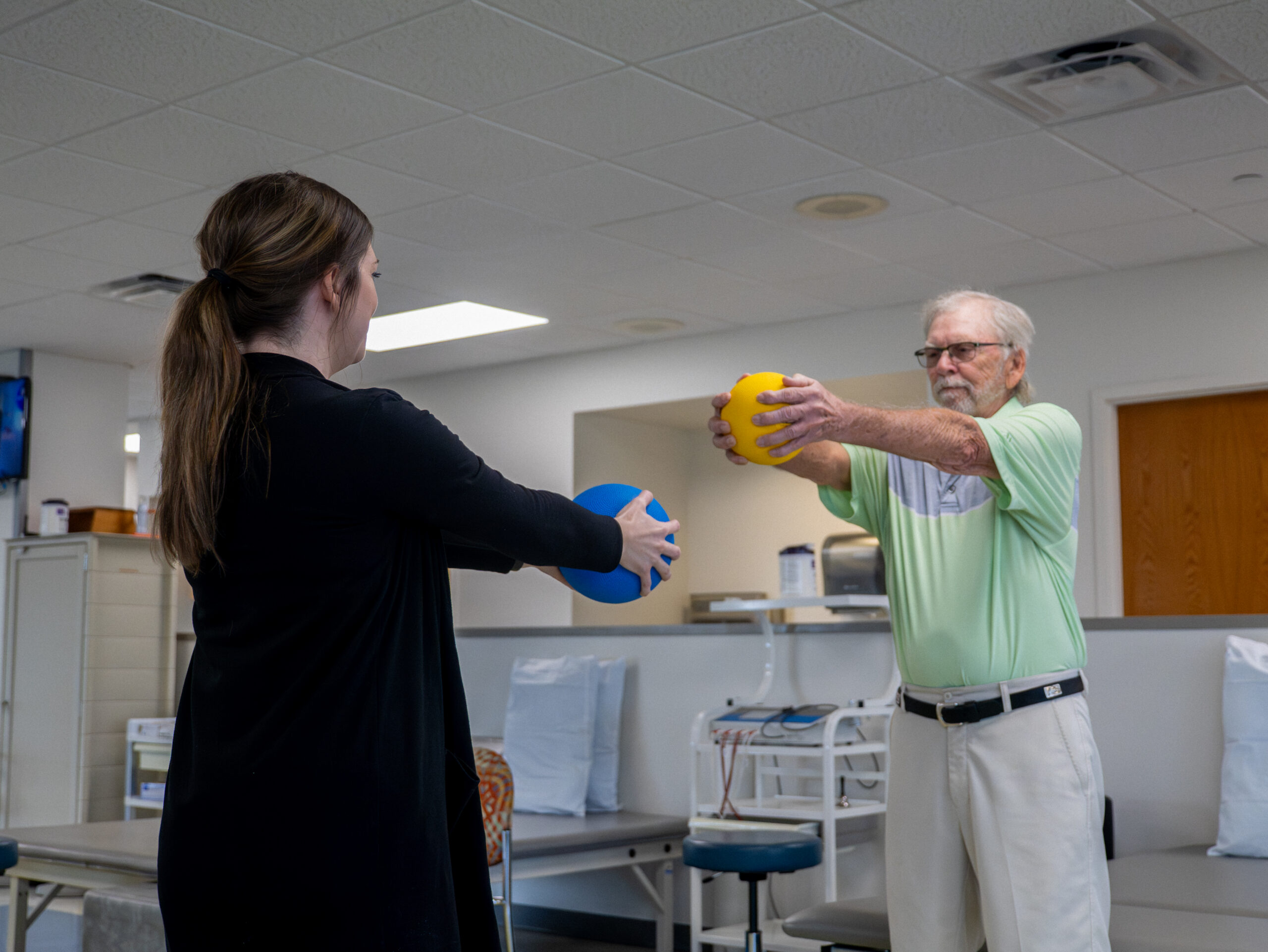
As he continued to find stability, he began the long journey of rehabilitation. At Methodist Rehabilitation Outpatient Therapy in Flowood, therapists began the painstaking work of rebuilding strength and nerve function. “They told me from the start, ‘Nerve damage recovery is not fast. It is slow. You’ll see tiny improvements, little by little. Sometimes it never fully comes back,” Robert says. “I didn’t want to hear that. I wanted instant results. But I did everything they said. Step by step.”
Patience became as essential as therapy. “I’m an impatient person,” he admits with a self-deprecating smile. “I wanted it all yesterday. But my wife kept reminding me, ‘Slow and steady. That’s how nerves heal.’ At first, it was frustrating. I wanted my life back immediately. But over time, I learned to celebrate the smallest victories.”
And the victories were small at first. “For months, I could barely lift my arm two inches,” he recalls. “Then one day, I raised it over my head. I was so excited, I could hardly believe it. That small motion, it meant I was reclaiming my body, my independence.”
Throughout his recovery, therapists like Joe Jacobson and Adrienne Brumfield guided him with care and persistence. “They didn’t just work with me in the clinic,” Robert explains. “They gave me exercises for home. They pushed me gently, encouraged me constantly, and when something didn’t work, they tried a new approach. They believed in me when I sometimes didn’t believe in myself.”
The process was grueling, not just physically but emotionally. “I went through a deep depression,” he admits. “There were days I felt hopeless. My body wasn’t cooperating, and the simplest tasks were exhausting. But the team at Methodist never let me quit. They reminded me that progress, no matter how small, is still progress.”
After months of dedicated therapy, Robert regained the ability to move, swallow, and walk with independence. He could raise his arms, rotate his neck, and once again engage in life’s simple pleasures. Golf, which had signaled the start of his ordeal, became the measure of his triumph. “I was scared to play again,” he says. “Nine months ago, I couldn’t have imagined swinging a club without hesitation. Now, I play, not like a pro, but enough to enjoy it. It’s proof that perseverance pays off.”
Robert emphasizes that recovery is about more than physical care. It’s about mindset. “If you ever experience nerve damage, you have to understand, it’s a slow process. You must do what your therapists say, put in the time, and be patient. It’s too easy to sit in a chair and say, ‘I’m tired.’ But every exercise, every step counts. That’s how you get better.”
Looking back, Robert is full of gratitude. “I’m a big fan of Methodist,” he says. “They’ve seen it all. They know what works, what doesn’t, and they don’t give up on you. The nurses and therapists went above and beyond. Because of them, I have my life back. I can play golf. I can move without fear. I can enjoy my days.”
“It was a hard journey, and it took time step by step, one small improvement at a time. Methodist helped me get back to life, and I can’t thank them enough. Today, I am a success story.”